As human beings, we need a visual system that we commonly call “eyes” as our window to see the world and to receive most of the visual information around us. Michael S. Gazzaniga (2012:157) has stated that the brain processes visual information roughly sixty thousand times faster than text. It happens because the brain directly processes everything our eyes receive. However, we need to process writings gradually. We must remember that our ability to communicate verbally needs learning words, and language is not our default ability; it works differently from our ability to see what we have by default.
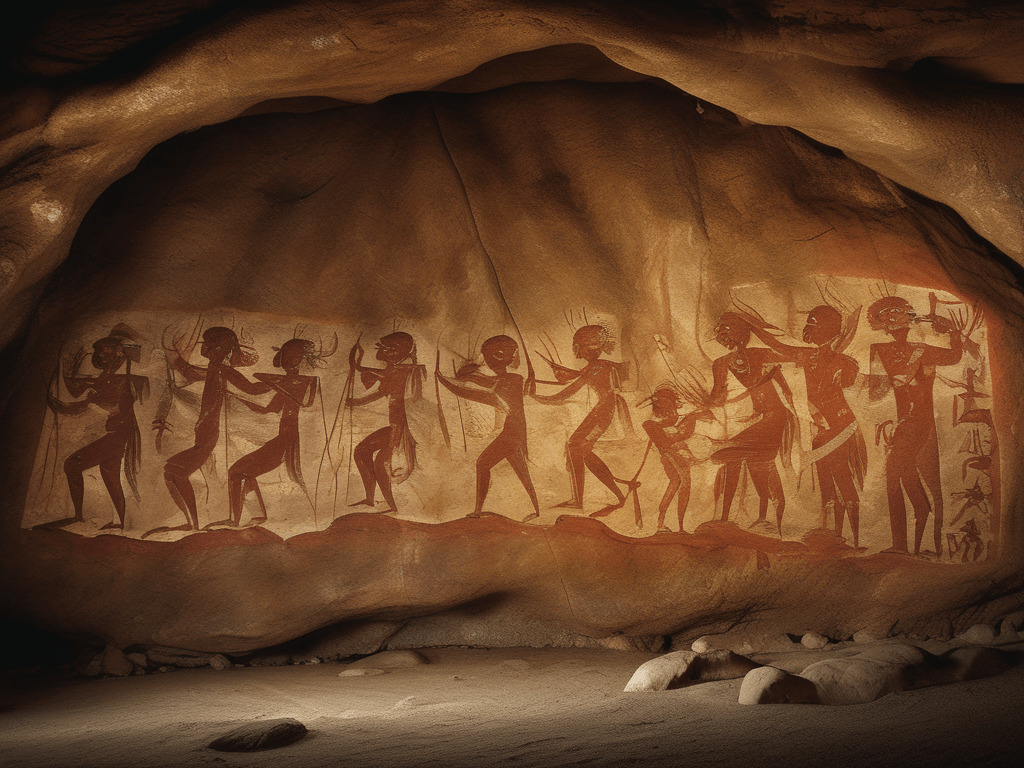
Seeing things creates motivation to duplicate every object we see into a simple drawing. The oldest figurative painting that humankind created in early civilization on earth and has lasted until now is in Leang Tedongnge cave, in Maros regency, South Sulawesi, created at least 45,500 years ago (Brumm et al.; 2021). Several cave paintings have been made throughout history, from the unadorned figurative painting in Leang Tedongnge cave to unspeakable numbers of artworks nowadays.
The development of artmaking techniques in our civilization has become more diverse. It started from the use of artwork for belief rituals. For example, the Venus of Hohle Fels, the oldest three-dimensional artwork, specifically figurine, portrays a fat woman presumed as a fertility goddess. It was found in Schelklingen town, Alb-Donau-Kreis district, Baden-Württemberg state, Germany. According to Stannard and Langley (2021), the mammoth-ivory statuette was created 40,000 years ago, in the Late Paleolithic period.
Humans have started to build solid constructions for belief rituals for thousands of years of their existence. The first one is Göbeklitepe, an archeological site in the northeast of Örencik village, Haliliye district, Şanlıurfa Province, Turkey; and it seems like a temple. According to Türkiye Kültür Portalı (Turkey’s Culture Portal), Göbeklitepe was built twelve thousand years ago, and it has many pillars with symbolic carvings of animals, such as crane birds, foxes, and buffaloes. This temple is the world’s oldest work of architecture, where humans started to establish buildings to gather and do their belief rituals.
Those three artifacts were a glimpse of examples of numerous human creative works created for humans’ basic needs in their early civilization. These artifacts aimed to fulfill their conceptual and emotional ideas (like the figurative paintings in Leang Tedongnge cave and Venus of Hohle Fels) or serve their belief needs (like Göbeklitepe temple). These purposes indirectly have made the artworks parts of human culture elements.
Throughout our civilization, artworks have played more than the role of cultural heritage due to their communicational characteristics, presenting an idea into a tangible object, passed down from generation to generation, and keep evolving. Thus, not only humans have shaped the artworks, but the relationship works in two ways, where artworks have also shaped our world since early societies. This relationship has led us to an unending connection where artworks can even authenticate the existence of a person, a society, a tribe, or a nation, as part of our culture.
When discussing the visual arts, we discuss the artwork itself. First, the artwork is a broad term, as different contexts and values require specific terms. For example, when an artwork has substantial cultural and historical values, we identify the work as an artifact (antique, heirloom, or relic), including inscriptions. While a device or a product is a functional context of the artwork, such as teapots, usually applied for general works without a timeframe. In artistic contexts and values, we use the artwork.
In the book of Pengantar Ilmu Antropologi (2003:202), Koentjaraningrat stated that there are seven elements of human culture. They are language, belief system, arts, technology system, economic system, social organization, and science. Arts, particularly the visual arts, have universally been classified into human culture. Because the visual arts exist in every society throughout times and places, with its three forms of culture, such as ideas, activities, and artifacts, as cited by J.J. Hoenigman.
Each person has unique ideas about anything through visual arts, either realistically or idealistically. Those ideas might encourage them to do something to create artworks; in this step, creativity exists. Then, the creative process (as the activity) will create artwork (artifacts). These artifacts will promote reactions as other people perceive. The response will generate new ideas inspired by the present arts.
The Oxford English Dictionary has defined art as below.
“The expression or application of human creative skill and imagination, typically in a visual form such as painting or sculpture, producing works to be appreciated primarily for their beauty or emotional power.”
In conclusion, art is a skill to create something through its display, application, or expression. When we generate ideas, we have no creativity yet. Creativity exists when humans begin the creation process that portrays their ideas into the real world and is perceivable by others through the five senses (sight, hearing, touch, smelling, and taste). Creativity is not about creating ideas only. Creativity is about creating, as the term creativity is originated from ‘create’, which stemmed from Latin’s creare, which means produced or formed out of nothing. As a result, when one creates a piece of art, we tend to call it an oeuvre (plural: oeuvres), which is the works of an artist regarded collectively.
Everyone has different levels of knowledge and perception of each other as they have come from different backgrounds; tribe, race, nationality, age, religion, education level, domicile, profession, etc. Moreover, these differences make a single artwork perceived by individuals differently because they might contemplate the art by different benchmarks that create different interpretations.
When we have a different person interpreting a shade of color in a cultural context, they can perceive the color shade differently. For instance, crimson red symbolizes happiness for the Han Chinese in Mainland China, East Asia. However, it represents hostility and war for the Sherbro people in Sierra Leone, West Africa. On the other hand, crimson red symbolizes divinity for the Māori people in New Zealand, Oceania’s Polynesia.
Education level, racial, religious, eco-social, geographic, and other backgrounds might influence how individuals perceive a shade. For instance, crimson red can be perceived differently by religious backgrounds; Christianity observes it as the color of divine sacrifice, Hinduism sees it as prosperity, and Shintoism sees it as divinity. Because of the diversity of each artistic element, such as color, creative people ought to understand the artwork contextually, through the time of creation, the audience experiences, the awareness of the artistic elements, or other things to be considered to create a relevant interpretation.
A High Renaissance Italian artist, Michelangelo, has stated that a man paints with his brain and not with his hands. This statement is related to the early creative process when we must find the idea based on something, then develop it as the conceptual background we have and the observation we do. The idea that comes into our mind is the root of the artistic creation, while our hands are only the ‘tool’ to portray what is inside our minds. The idea always leads us to many paths of understanding to open our horizons through observation. It starts with a concept planning (such as creative reasoning and the relationship with society’s perception) until the end of the artmaking process.We can now conclude that visual arts are part of human culture, relating to a skill that allows humans to communicate visually to fulfill their needs. Based on their knowledge and perception, people will create anything realistically or idealistically in forms that people perceive by sight and touch.


 Brush & Hush
Leave a comment